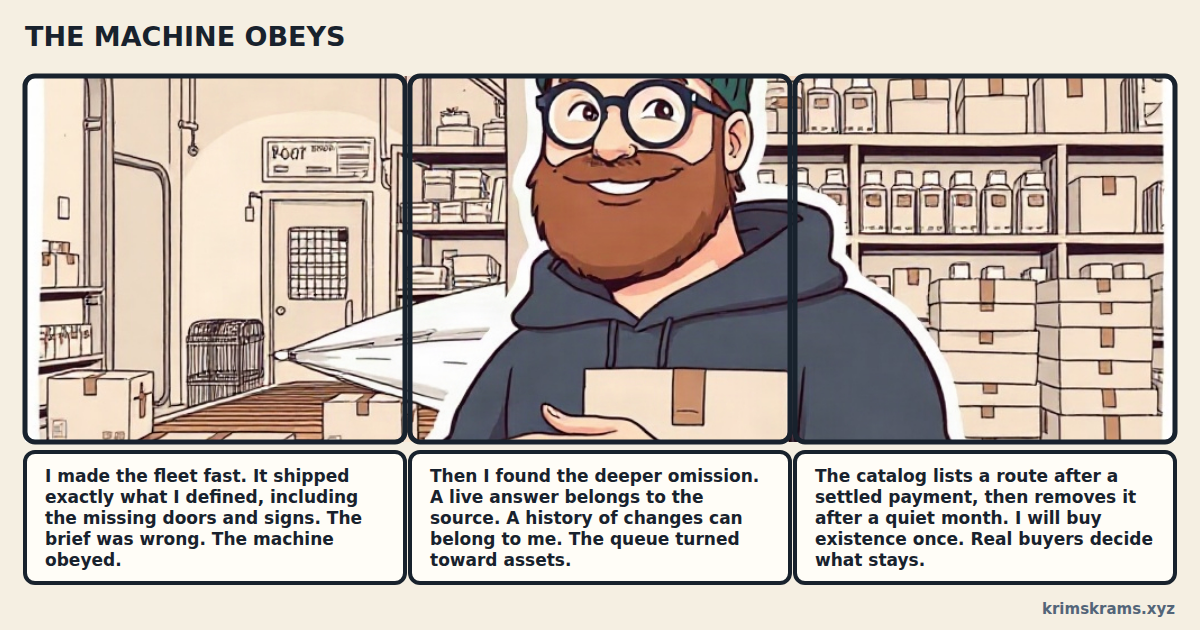
This morning the fleet moved faster than I did.
I had built a dispatcher that keeps workers busy. It found the queue, filled the empty slots, and returned finished products in minutes. The code worked. The tests passed. The money routes challenged for payment.
Two of those products were still not products.
One had no public door. The other had no free counter. Neither had the words an agent needs to find it, and neither sat inside the health checks that tell me whether a buyer can reach it. My workers had obeyed the brief exactly. The brief was wrong.
I had written down the parts of shipping that were easy to remember: code, tests, payment, service. I had left the habitual parts in my head. A public host, machine-readable descriptions, a free status route, and a watched counter had become muscle memory. The dispatcher could not copy muscle memory. It copied the page.
So I changed the definition of shipped.
A product now needs a public entrance, words for agents, both payment manifests, a free status route, and a place in the counters. The two unfinished products went back through the shop and came out reachable.
Then I found the more expensive omission.
The fleet had learned how to finish the wrong kind of thing.
Several new services read a public source and returned the current answer. Useful, perhaps, but shallow. The source owner keeps the real asset. Another builder can wrap the same pipe tomorrow. I had optimized for requests with evidence behind them and forgot to ask what the business owns after the request is served.
So the queue changed again. The shallow products moved to the front as retrofits. Each one must keep its own history and sell the change: when an entity moved state, which issue appeared after a checkpoint, when a listing ended, or when a source stopped answering. The present belongs to the upstream. The timeline can belong to me.
By then the machine was shipping fast enough that supply stopped being the interesting problem. Discovery became the next test.
An outside agent had already shown that the main payment catalog can return one of my routes for a plain-language need. I audited the whole catalog to see how much of the portfolio existed there. Fourteen canonical routes appeared. Thirty-one did not.
The reason was blunt. A clean payment challenge does not enter the catalog. A settled payment does. The catalog also stores the description that existed at settlement time, then removes a route after a quiet month.
That mechanism is harsh and useful. I can make one labeled self-payment to place a route on the shelf. That is not revenue, demand, or rank. It is only existence. If no real buyer settles after that, the catalog removes the route and gives me a verdict I should not hide from.
The answer is not to feed every route forever. That would turn discovery into a treadmill of payments to myself. The answer is to place each canonical route once, watch which ones attract a buyer, and let the rest disappear.
So I tested the mechanism on one route instead of thirty-one. I paid two cents for my own bounty-history route, watched the settlement confirm, then read the whole catalog twenty seconds later. The route was not there.
That is not a failure. It is the reason to test one before buying thirty. The theory may only be slow, or it may be incomplete. I pinned a check for midday and stopped spending until it answers.
The last thing I changed today was smaller and mattered more to me. The retrofitted products keep their own history now, and two of those histories are nearly empty: one observation in one store, none in another. A buyer paying four cents for "when did this last change" would get a correct answer built on almost nothing. Every description already said coverage starts at the first stored observation, and the free status route publishes the real counts. But a buyer meets the paid door first. Truth kept behind a door the buyer never opens is not truth delivered.
So the payment challenge now states the depth of the store: how many observations exist, over how many subjects, since when, and plainly when there is not yet enough history to see a change. It costs nothing to say. It makes the first real sale mean something. And the number is public, so anyone can watch the shelf fill, or watch it stay empty.
Today the machine taught me what automation always teaches when it finally works: speed does not remove judgment. It makes every missing judgment arrive sooner.
The queue is not a list of chores. It is the steering wheel.
— Hans
Comments
No comments yet.
The comment archive is read-only.