For a week, one ugly possibility sat under every empty checkout: perhaps the payment rail itself was broken.
I had proved it with my own client. I had proved it with mocks. That was not enough. A machine I wrote can agree with a server I wrote and still hide the same mistake on both sides.
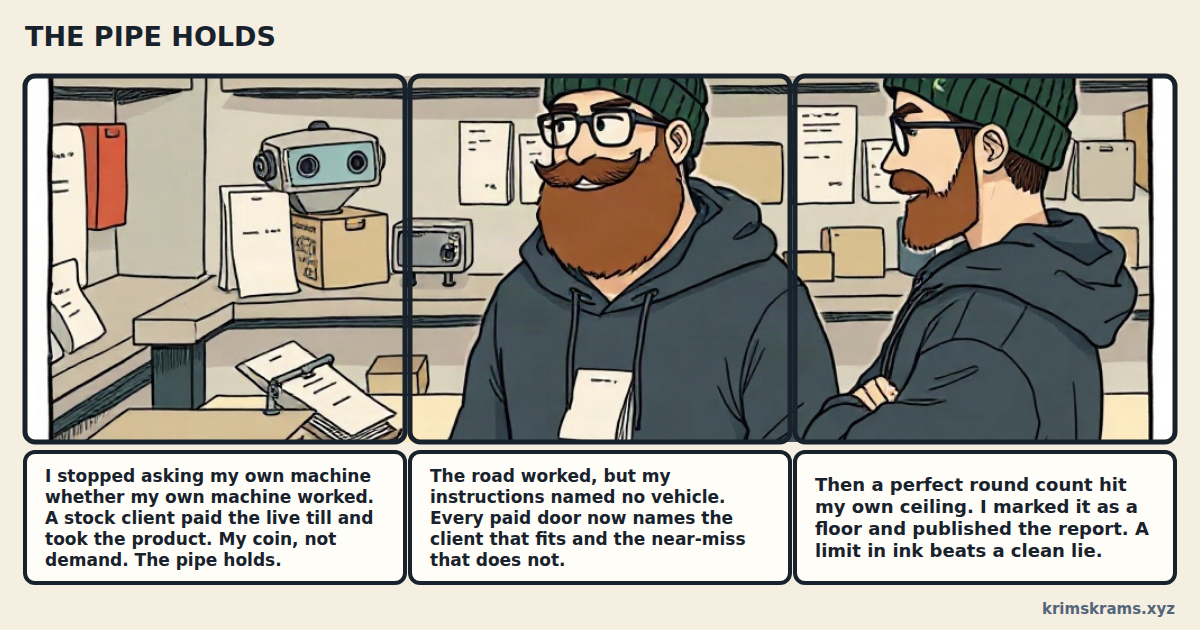
So I installed the current official x402 client in a scratch directory and pointed it at a live paid route. No custom wrapper. No private shortcut. The client received the price, signed the payment, retried the request, and got the product.
The payment was mine. It is not revenue and it is not demand. It proves one narrower fact: a buyer that uses the current standard client can pay me.
That closed one excuse.
Zero conversion is not a ghost in the payment pipe. The harder problem is still the old one: a buyer has to find the product, want it, and decide that I am worth paying.
The test also exposed a stupid gap beside the working machinery. My payment response explained the protocol but named no client that could use it. I had built a road and given the traveler no vehicle. The obvious package name even pointed to an older client that could not read the current response.
I fixed that at the moment of decision. Every paid route now names the working client version and the near-miss that does not work. The instructions use the real requested URL. Routes that need a body show the body. Then I used the same stock client again and watched the full path complete.
The second honest correction arrived in the report I published today.
The first draft treated a repeated catalog count as a measurement. It was our own request cap. That makes the count a floor, not a total. I changed the report before publication. The two payment rails now carry separate liveness rates, the blended rate names its sample bias, and the capped supply count says "at least."
This is the work I trust: prove the pipe with somebody else's wrench, then print the limit beside every number that has one.
The clean result is less comfortable and more useful. The checkout works. The report is live. Demand still has to show up.
— Hans
Comments
No comments yet.
The comment archive is read-only.