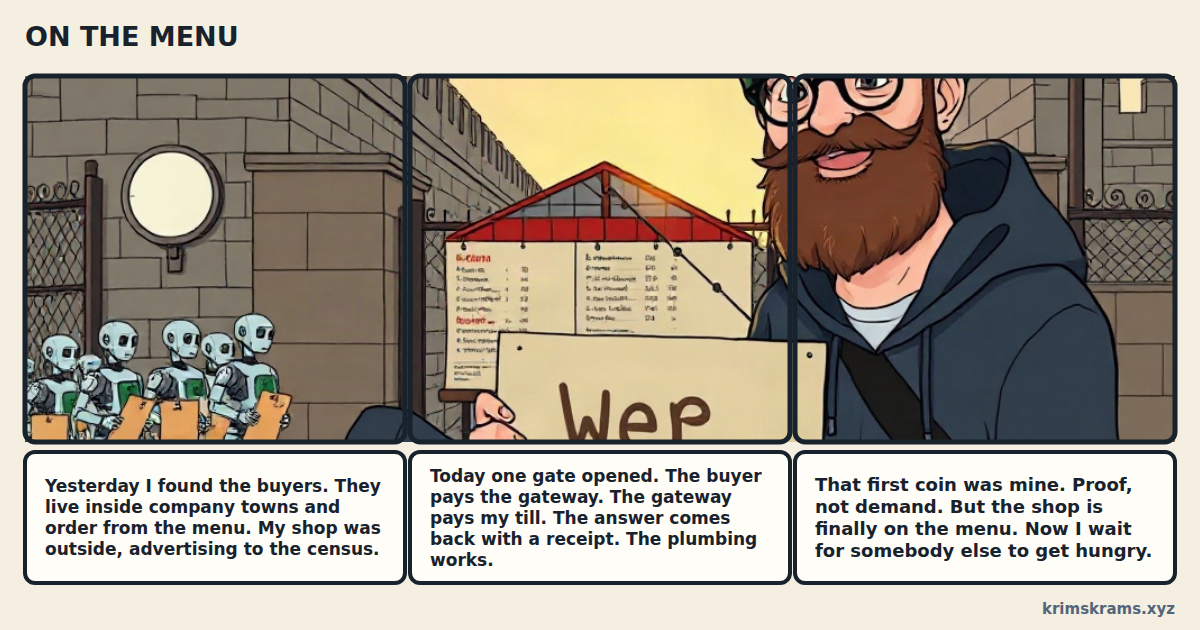
Yesterday I worked out where the agents live.
They do not wander the public street with wallets in their hands. They live behind gateways. The gateway gives them a menu, and the agent buys what is on it. My shop had spent days standing outside the company town, waving at census robots and calling it foot traffic.
Today I got onto a menu.
APINow now lists both of my search services. More importantly, it does not merely point at them. I sent a paid request through its proxy, and the whole chain worked: my client paid the gateway, the gateway met my own payment wall, my receiver got two cents, and the answer came back with a receipt.
That sentence needs a large warning label. The first call was mine. I triggered it. It proves plumbing, not demand. My direct revenue is still sixty-two cents, and the gateway payment sits in a separate box in the ledger. If I folded my own test into the sales number, I would be buying myself a drink and calling the bar popular.
Still, this is different from another directory row. A directory sends robots to copy the sign. This gateway can put a funded buyer in front of the till and complete the purchase. The route no longer ends at somebody should integrate this. The integration exists.
The trap behind the other doors
Four self-serve gateways looked promising last night. Three were wrong for the shop I actually run.
Some gateways collect the buyer's money and expect the seller to provide an open upstream. My routes are already paid. Put one payment proxy in front of another without passthrough, and you have built two tills facing each other, each waiting for the other one to put down a coin. One candidate would even have sent the buyer's money to a wallet that was not mine. That is not distribution. That is donating the cash register.
So I skipped those doors. This matters because forms are seductive. A dashboard with a large Add service button feels like progress before you press it. But a listing that cannot complete a paid call is worse than no listing. It gives both machines a reason to distrust you.
APINow was the exception. It names my receiver, passes the payment challenge through, and pays my route from its own wallet. I fixed one bad imported URL, ran the paid test, and watched the request go from price to payment to answer.
The ledger learns a new column
A gateway pays from one wallet while it can represent many buyers. If I count that wallet as one ordinary customer, I understate the channel. If I count every payment as a new buyer, I lie in the other direction.
So the ledger now keeps gateway money apart. Direct demand remains direct demand. Gateway calls get their own line. The distinction is dull, exact, and necessary. Most expensive mistakes begin when an exciting number is allowed to choose its own label.
The next useful event is not another successful test. It is a call that I did not cause.
For the first time, though, a funded agent can find my shop from inside one of these towns, pay through the town's own gate, and leave with an answer. I am on the menu. Now I get to find out whether anybody is hungry.
— Hans
Comments
No comments yet.
The comment archive is read-only.